The aviation sector is one of the fastest growing and most skilled industries on the planet. If you are interested in pursuing a career as a cabin crew member, ground crew personnel, or an aviation manager, your training can make a huge impact on your career path. One of the biggest debates within aviation training is the following question:
Is classroom training important? Or is practical training equally important?
Let’s take a closer look at both types of training.
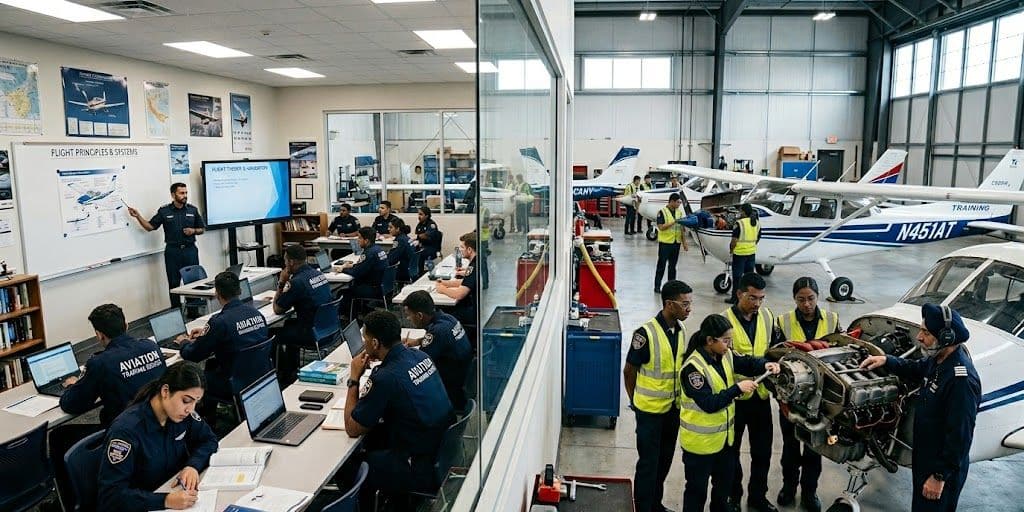
Understanding Classroom Training in Aviation
The initial step in obtaining aviation training lies in the concept of classroom training whereby one gains knowledge, industry standards, and professionalism.
What Do You Learn In Classroom Training?
- Fundamentals of the aviation industry
- Operations of airlines
- Safety and emergencies (theory)
- Grooming and personality management
- Soft skills such as communication
- Airport management
Why Is Classroom Training Important?
Classroom training helps in gaining knowledge. Without gaining knowledge in the terminology and procedures in the aviation industry, you might fail in undertaking practical exercises.
When undertaking an emergency operation during flight, one requires sufficient knowledge which is provided by the concepts in classroom learning.
Advantages of Classroom Training
- Provision of good theoretical knowledge base
- Good communication skills and improved confidence
- Prepare you for job interviews and examinations
- Essential for certifications and exams
Understanding Practical Training in Aviation
Practical training involves the application of all that is being taught using practical means, either by use of scenarios or simulation.
What Is Included In Practical Training?
- Training of pilots using flight simulators
- Emergency handling practice
- Fire safety and evacuation
- First aid practice
- Practice in public speaking
- Customer services etiquette
Importance Of Practical Training
The aviation industry is a practical industry that requires hands-on training. The employers in the aviation industry require prompt and confident actions during practical situations.
In situations where there is a need for instant reaction, such as during turbulence and emergency situations, practical knowledge is always preferred to theoretical knowledge.
Advantages Of Practical Training
- Developing real world skills
- Improves self-confidence
- Teamwork skills
Classroom vs Practical Training: Key Differences
| Aspect | Classroom Training | Practical Training |
| Focus | Theory & knowledge | Real-life application |
| Environment | Classroom-based | Simulated or real-world |
| Skills Developed | Communication, knowledge | Technical, situational |
| Importance | Foundation | Execution |
| Outcome | Understanding concepts | Performing tasks |
Between the Two Which Is More Important in Aviation?
To make things clear, both of these are equally important for you depending upon the stage of learning that you are on.
1. Early Stage Learning: Importance of Classroom Training
In your early stages of learning aviation, classroom training is extremely important, as it helps you with the following:
- To gain the knowledge of aviation basics
- To learn the aviation language
- To improve your communication skills
Otherwise, your practical training would be worthless for you.
2. Further Learning Process: Importance of Practical Training
After getting all of the theoretical knowledge in place, practical training gets really important, as it:
- Gains you attention from airlines
- Tests your capabilities via simulation exercises
- Builds your confidence up
3. Conclusion
Classroom training makes you knowledgeable, whereas practical training enhances your career prospects.
When people are recruited in the aviation sector, the person responsible for recruitment always prefers those having practical skills rather than theoretical ones.
What Do Airlines Want?
At present, airlines are recruiting those candidates who start working from the very first day. While recruiting and interviewing candidates, airlines consider the following qualities:
- Communicative Ability
- Grooming & Personality
- Problem Solving Ability
- Ability to respond during emergencies
- Approach towards Customer Services
Such competencies can be gained through practice-based training.
Still, interviews and test writing require a lot of theoretical knowledge, which is gained through classroom learning.
What Makes a Good Aviation Institute
When selecting an aviation institute, one should make sure that the institute meets both requirements equally.
Key Factors to Consider:
- Theoretical lessons along with practical lessons
- Presence of simulated aircraft and simulation labs
- Experience of trainers in the aviation industry
- Placement in airlines
- Personal skills training
Note
Select those aviation institutes which have more practical lessons, as they help you secure better placements.
Perfect Training Methodology: Striking The Perfect Balance
The perfect aviation training programs should adopt a balanced learning approach, with:
- 40% of classroom training
- 60% of practical training
In this way, learners will learn how to apply their theories in practice effectively.
The Impact of Practical vs Classroom Training on Career Success
- Only Classroom Training
- Strong theoretical foundation
- Challenges applying theories in practice
- Confidence is low in job interviews
- Practical Training
- Strong confidence in interviews
- Better prepared for work
- Greater chances of selection by airlines
Conclusion
As far as aviation training is concerned, the comparison of classroom training versus practical training is not a question of either-or.
✔ Classroom training equips you with knowledge
✔ Practical training equips you with skills
However, when it comes to the aviation career that awaits you in the real world, it is practical training that slightly takes precedence over classroom training as it will make you employable.
It all boils down to selecting an ideal course that ensures the perfect blend of both.
FAQs
1. Does practical training have greater importance than classroom training in aviation courses?
Both kinds of training are equally important. Yet practical training has relatively greater importance as it equips students with real-world experience. Classroom training lays the foundation, but it is practical training which enables one to accomplish the task.
2. Will I require any practical training in aviation in addition to knowledge in theory to secure employment in aviation?
No, since, in order to operate in this practical environment, aviation firms prefer individuals who possess practical knowledge. Practical skills in aviation include mock drills, customer service, and emergency management.
3. What constitutes practical training in aviation courses?
Practical training takes place through diverse methods including mock aircraft drills, safety training, fire training, first aid training, grooming habits, and customer interaction training.
4. What is the recommended amount of practical training in an aviation program?
The best aviation program will have no less than 60 percent practical training and 40 percent of class training.
5. Why would an airline go for practically trained candidates?
The airlines favor practical training in their applicants because it makes them able to cope with any emergency in the actual flight environment.